
Quick Summary
The best paints for commercial metal siding are direct-to-metal acrylics, waterbased alkyd urethanes, multi-surface acrylics, industrial enamels, and metal-building coatings like V Cote. The right choice depends on substrate, exposure, and whether the existing finish is sound. Surface preparation determines whether any commercial metal siding paint lasts.
- Pro Industrial DTM Acrylic suits bare or primed metal siding from a commercial high-performance line.
- Confirm the current product data sheet, coverage rate, and warranty terms before buying.
- Test adhesion with tape on previously painted panels before recoating.
- Clean galvanized panels with detergent to remove mill oil that blocks adhesion.
- Paint over active rust or trapped moisture causes blistering, so clean to bare metal.
Table of Contents
- Why Commercial Metal Siding Needs Specialized Paint
- Comparison Table: Five Paints at a Glance
- Metal Siding Surface Preparation Before You Paint
- The 5 Best Paints for Commercial Metal Siding
- Choosing Finish, Color, and Durability for Metal Buildings
- Booking Your Commercial Metal Siding Paint Job With Patriot Painting
- Frequently Asked Questions
Why Commercial Metal Siding Needs Specialized Paint
Last Updated: November 20, 2026
Commercial metal siding faces harsher conditions than most residential exteriors, which is why the paint choice matters so much. The right coating can protect a building for years, while the wrong one may peel, chalk, or rust within a few seasons. Choosing among the five best paints for commercial metal siding starts with understanding what the surface needs.
Metal siding is typically steel or aluminum, often coated at the factory with a galvanized or Galvalume finish. Those surfaces are smooth and dense, so paint has little to grip onto. ArmorThane’s 2026 guide to metal roof paint recommends a direct-to-metal acrylic system for most painted, galvanized, or Galvalume metal roofs, applied in two coats at 50°F or higher. Those same adhesion and temperature considerations apply to siding.
Commercial buildings also carry different demands than homes. Warehouses, retail centers, and industrial facilities often need coatings that resist fading, chalking, and corrosion while holding color over many years. Valspar’s metal building siding and roof finish markets its product around rust and corrosion resistance, excellent adhesion, and fade and chalk resistance, which reflects the priorities most commercial owners share.
Comparison Table: Five Paints at a Glance
The table below summarizes the five coatings we review in this guide. For current pricing, request a quote through Patriot Painting Services’s website.
| Paint | Coating Type | Best For | Finish Notes |
|---|---|---|---|
| Pro Industrial DTM Acrylic | Direct-to-metal acrylic | Bare or primed metal siding | Commercial high-performance line |
| Pro Industrial Waterbased Alkyd Urethane | Waterbased alkyd urethane | Commercial projects needing a waterbased option | Commercial high-performance line |
| Pro Industrial Multi-Surface Acrylic | Multi-surface acrylic | Buildings with mixed substrates | Commercial high-performance line |
| Pro Industrial Industrial Enamel | Industrial enamel | Heavy-use commercial exteriors | Commercial high-performance line |
| V Cote | Metal-building coating | Metal buildings specifically | Flat and midsheen available |
Metal Siding Surface Preparation Before You Paint
Preparation determines whether any paint lasts, and on commercial metal siding the correct preparation depends on which of three conditions you are facing: factory-finished or galvanized panels, previously painted panels, or rusted and failing panels. Treating all three the same is the most common reason a new coating peels within a season or two.
Galvanized and Galvalume panels. These surfaces are smooth and can carry a mill oil or passivation film that blocks adhesion. Wash with a detergent solution and rinse thoroughly, then abrade the surface so the coating has a profile to grip. Where the substrate is galvanized and has never been painted, a bonding primer or a direct-to-metal acrylic formulated for that surface is often the right starting point. Watch out: skipping the wash on new galvanized panels leaves mill oil under the film, and the coating can release in sheets months later.
Previously painted panels. The new coating must bond to the old one, not to the metal. Test adhesion first by pressing tape onto a small cleaned area and pulling it off; if paint lifts, the existing film is unsound and needs to be removed or sealed with a compatible primer. Identify whether the old coating is acrylic, alkyd, or a factory finish, because a waterbased acrylic over an unknown alkyd, or a solvent coating over a factory finish, can fail at the bond line even when each product is individually sound. Feather any edges and spot-prime bare metal before the full coat.
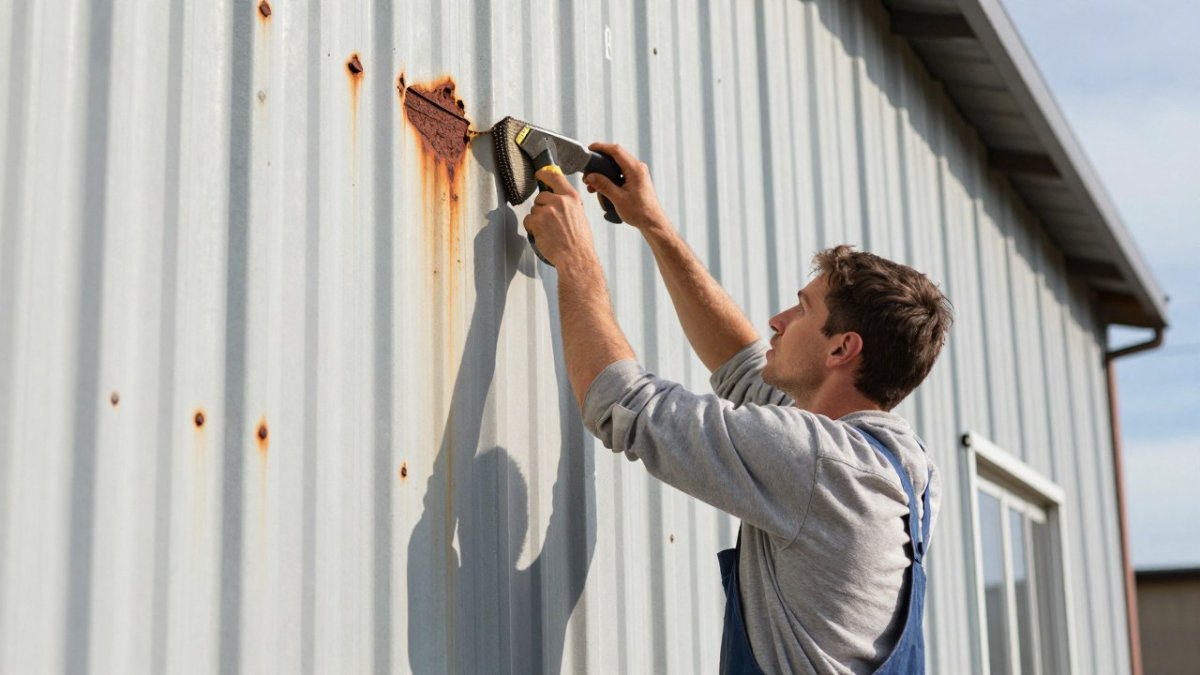
Rusted and failing panels. Rusted spots should be cleaned to bare metal wherever possible, then primed with a rust-inhibitive primer before the topcoat. Where pitting is deep, the panel may need replacement rather than coating, because paint over active rust will blister again. Dented or damaged panels can also affect how a paint film holds up, so repair or replace compromised sections before painting so the new coating covers a sound surface rather than masking a problem. If your siding is dented or surface-damaged, you can learn more about our drywall repair and texture coatings work.
Application conditions. Check the manufacturer’s application conditions before you begin, since most exterior coatings perform best above 50°F and in dry weather. On commercial work, also plan for wind and overspray: spray application is faster on large facades but requires masking and a spray plan, while roller and brush work is slower but easier to control around occupied entrances and adjacent properties. Respect the recoat window printed on the data sheet; recoating too soon traps solvent, and recoating too late can require abrasion before the next coat.
Safety and site rules. Commercial repaints often happen on occupied properties, so confirm ventilation, PPE, and any volatile organic compound limits that apply to the coating you select, and keep the product data sheet and safety data sheet on site. Watch out: painting over trapped moisture or unremoved rust causes blistering that appears months later, so do not skip the cleaning step to save time.
The 5 Best Paints for Commercial Metal Siding
No single coating is the best choice for every commercial building. The five options below are the products listed in the supplied information, and each suits a different substrate, exposure, or finish goal. Treat this as a shortlist for evaluation, not a universal ranking: confirm the current product data sheet, coverage rate, and warranty terms with the manufacturer before you buy.
1. Pro Industrial DTM Acrylic
Pro Industrial DTM Acrylic is designed for direct-to-metal application, which can simplify the coating process on suitable surfaces. DTM acrylics typically bond directly to clean, sound metal and form a flexible film that moves with the panel as it expands and contracts, which is why they are common on metal siding and roofing.
Best for: commercial owners who want a direct-to-metal acrylic from an established commercial coatings line.
Skip if: your siding has heavy rust that needs a dedicated primer system first, or if the existing coating is an unknown alkyd that may not accept a waterbased topcoat without a bonding primer.
2. Pro Industrial Waterbased Alkyd Urethane
This waterbased alkyd urethane sits in the same commercial high-performance range. That trade-off matters on commercial facades where a uniform sheen and long color life are priorities.
Best for: projects that specifically call for a waterbased alkyd urethane, especially where a harder, glossier film is wanted.
Skip if: you need a coating confirmed for every metal substrate, since the supplied information does not verify that for all surfaces, or if the job site cannot meet the product’s recoat and cure windows.
3. Pro Industrial Multi-Surface Acrylic
Multi-surface acrylic coatings suit buildings that combine metal with other materials. If a commercial property has mixed substrates, one product across all surfaces can simplify ordering and color matching. The practical benefit is fewer SKUs on site and a single color batch across metal, masonry, and trim, which reduces the chance of sheen and color mismatch at transitions.
Best for: buildings with several surface types that need one acrylic system.
Skip if: you only have metal siding and want a metal-specific product, since a multi-surface coating may not match the corrosion package of a dedicated DTM metal coating.
4. Pro Industrial Industrial Enamel
Industrial enamel offers a hard, durable film suited to heavy-use exteriors. It is a clearly identified coating type within the same commercial line.
Best for: commercial exteriors that take frequent wear or contact.
Skip if: you want a flexible, easy-to-recoat finish, since enamels can be harder to repaint later and may require a compatible primer before a different chemistry goes on top.
5. V Cote
Best for: metal buildings where a flat or midsheen finish is preferred.
How to compare these five before you buy
Ask each manufacturer or supplier for the same four data points so the comparison is apples to apples: the published coverage rate in square feet per gallon, the recommended dry film thickness and number of coats, the recoat window at your expected application temperature, and the written warranty terms for commercial metal siding. Also confirm compatibility with the existing coating: a waterbased acrylic over an unknown alkyd, or a solvent coating over a factory finish, can fail at the bond line even when each product is individually sound.
Choosing Finish, Color, and Durability for Metal Buildings
Finish and color affect both appearance and durability. Flat finishes hide surface imperfections but can show dirt more readily. Midsheen finishes offer a little more washability and a modest sheen that many commercial owners prefer.
Color choice matters too. Darker colors absorb more heat, which can stress a coating over time, while lighter colors reflect more sunlight. Confirm fade and chalk resistance on the product data sheet before you commit to a color for a large building.
Durability depends on preparation, application conditions, and maintenance as much as on the product itself. Schedule periodic inspections to catch early signs of rust or film breakdown, and touch up small areas before they spread.
Booking Your Commercial Metal Siding Paint Job With Patriot Painting
Selecting the right coating is only part of a successful project. If you want help matching a paint system to your building, contact our team to review the substrate and discuss options. You can also explore our roof painting services for metal roofing projects, or see our exterior painting services for siding repaints. When you are ready to move forward, request a quote from our team and we will schedule a site review.
Frequently Asked Questions
What type of paint is best for painting metal siding?
For most commercial metal siding, a 100% acrylic direct-to-metal paint is a practical starting point. ArmorThane’s 2026 guidance recommends a 100% acrylic DTM paint over an acrylic bonding primer for most painted, galvanized, or Galvalume metal roofs, applied in two coats at 50°F or higher. Substrate condition matters, so confirm the product suits your existing coating and the metal underneath before ordering material.
Do you need to prime before using DTM paint?
It depends on the substrate. ArmorThane’s guidance calls for an acrylic bonding primer under 100% acrylic DTM paint on most painted, galvanized, or Galvalume roofs. Bare or heavily weathered metal may need a primer specified by the coating manufacturer. Always check the product data sheet for the surface you are painting, and avoid applying coatings below the minimum temperature listed on the label.
How should metal siding be prepared before painting?
Preparation starts with cleaning off dirt, chalk, and mildew, then removing loose paint and treating rust. Galvanized siding often needs a bonding primer because fresh paint adheres poorly to slick zinc. Previously painted siding should be checked for peeling or chalking, since failing coatings must be removed before repainting. Proper prep is the most common reason new paint fails early.
Can you paint commercial metal siding without removing the existing coating?
In many cases yes, provided the existing coating is sound, well adhered, and clean. Loose, flaking, or heavily chalked finishes generally need to be removed or spot-treated first. You can request a consultation through the company website for a project-specific assessment.
